
Call flow
How inbound calls are answered and routed — a map of the call-handling building blocks (auto attendants, ring groups, call queues, conferences, paging, service flags, park orbits), each with its own in-depth guide.
Call flow is where you decide what happens to a call once it arrives. A phone number (from Phone numbers) delivers a call to a routing target, and the targets live here: AI voice agents, menus that ask the caller what they want, groups of phones that ring together, queues that hold callers for agents, and the time-based switches that change all of the above by time of day.
The landing page, Routing & call handling, shows a card for each object type with a count and quick links to Manage the list or create a New one.
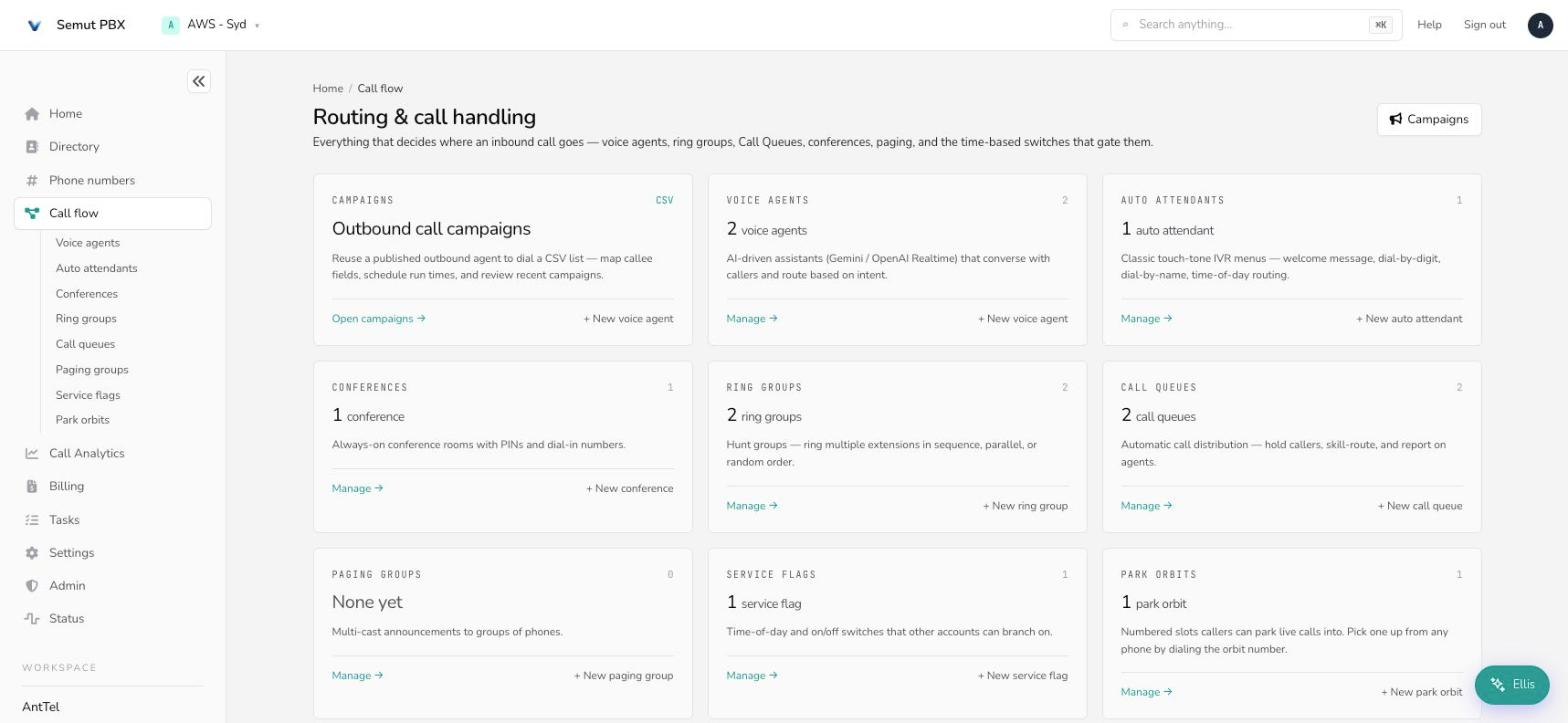
The building blocks
This chapter is the map. Each building block has its own in-depth guide — here is what each one does and when to reach for it:
- Voice agents — AI-driven assistants that hold a real conversation with a caller, answer from your knowledge, and can book appointments or take actions before ever routing the call. The most capable front door for a number, when a fixed menu isn't enough.
- Auto attendants — a touch-tone menu that answers a call and routes the caller by the key they press ("press 1 for sales, 2 for support") or the name they dial. The classic front door for a main number.
- Ring groups — ring several extensions together, in stages, so a whole team (sales, reception, support) is reachable on one number.
- Call queues (ACD) — hold callers in line with position and wait-time announcements and distribute them to logged-in agents. For contact-centre-style answering where calls should wait rather than ring out.
- Conferences — dial-in rooms where several people share one call, with an optional access code and moderation.
- Paging groups — one-way overhead announcements to the speakers of many phones at once ("the store closes in ten minutes").
- Service flags — simple on/off switches ("are we open?") that other objects branch on; flip one to move the whole system into night or holiday mode.
- Park orbits — numbered slots to drop a live call into and pick back up from any phone. Shared hold: park it, page the person, they retrieve it.
Every object shares the editor conventions from Getting around (tabs, the What this means rail, Save/Reset), and each has an Account number — the internal number you dial to reach it directly.
For detailed configuration steps and options can be found here****.
Everyday tasks
- Build an AI receptionist that answers questions and books appointments → Voice agents: set up its Assistant and Knowledge, connect a calendar if it should book, then publish it.
- Build a phone menu → Auto attendants: set the welcome greeting, map each key to a destination, then point a number at the attendant in Phone numbers.
- Make a team ring together → Ring groups: add members to stage 1, set durations and escalation.
- Queue callers for agents → Call queues (ACD): set the agents and selection rule, then the caller announcements and optional callback.
- Switch to after-hours automatically → Service flags: set your hours, then reference the flag in an attendant's greeting or redirection.
- Open a meeting line → Conferences: set the access-code length and participant limit.
- Set up overhead paging → Paging groups: add the member phones.
- Add a shared hold slot → Park orbits: note the orbit number to dial.
Next: Call Analytics — the record of every call these routes produced.