
Ring groups
Ring several extensions together, in stages, so a team is reachable on one number.
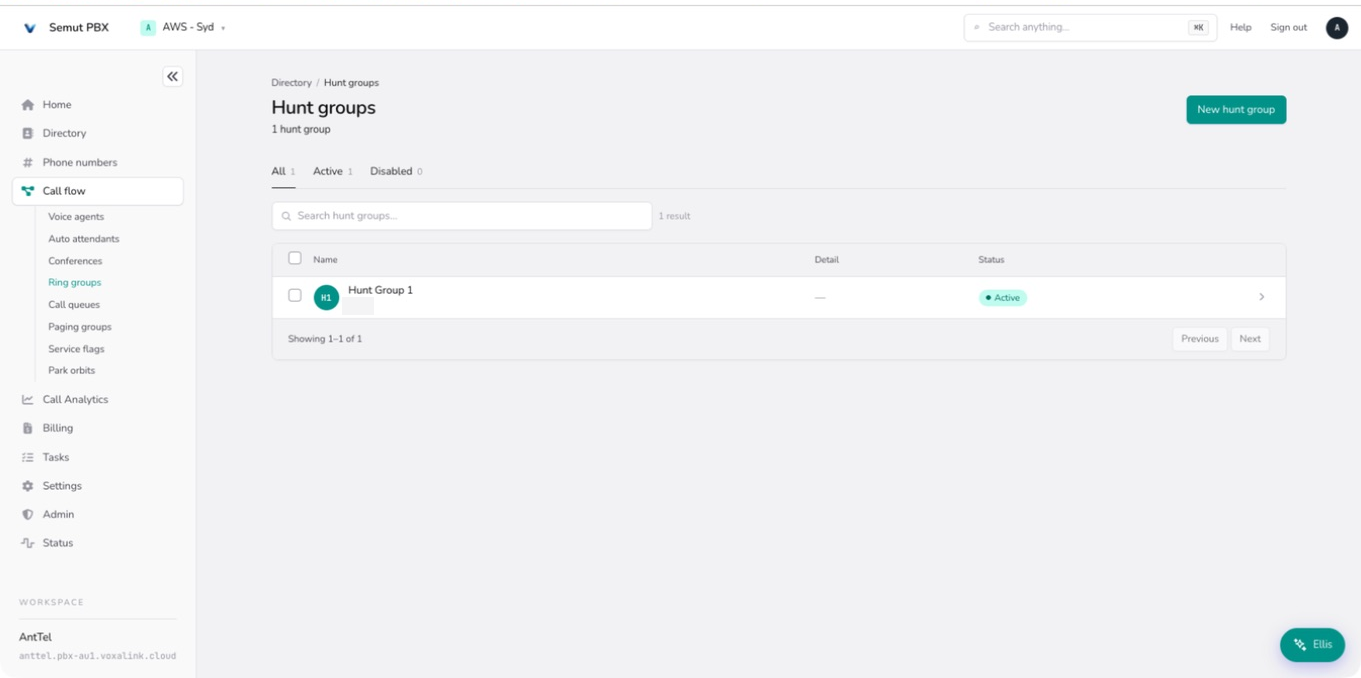
A ring group rings several extensions for one call — use it for a team that should all be reachable on one number, such as sales, reception, or support. The call is offered to the group and whoever answers first takes it. Find them under Call flow → Ring groups (they're also called hunt groups).
Ring group vs. call queue A ring group rings a set of phones and connects the first to answer — there's no line, no hold music, no waiting. A call queue holds callers in line with music and announcements and hands them to agents one at a time. Reach for a ring group when a call should simply ring the team; reach for a queue when calls should wait to be answered.
How a ring group works
A ring group rings its members in stages. There are three ordinary stages plus a final stage:
- Stage 1 rings its extensions for a set number of seconds.
- If nobody answers, the group moves to stage 2, then stage 3 — each adding more phones.
- The final stage is the last set of extensions to try before the call ends up unanswered.
If an extension is busy or unregistered it's simply skipped, and the group keeps moving through the stages. Keep each stage to a handful of phones rather than ringing a whole floor at once.
Creating a ring group
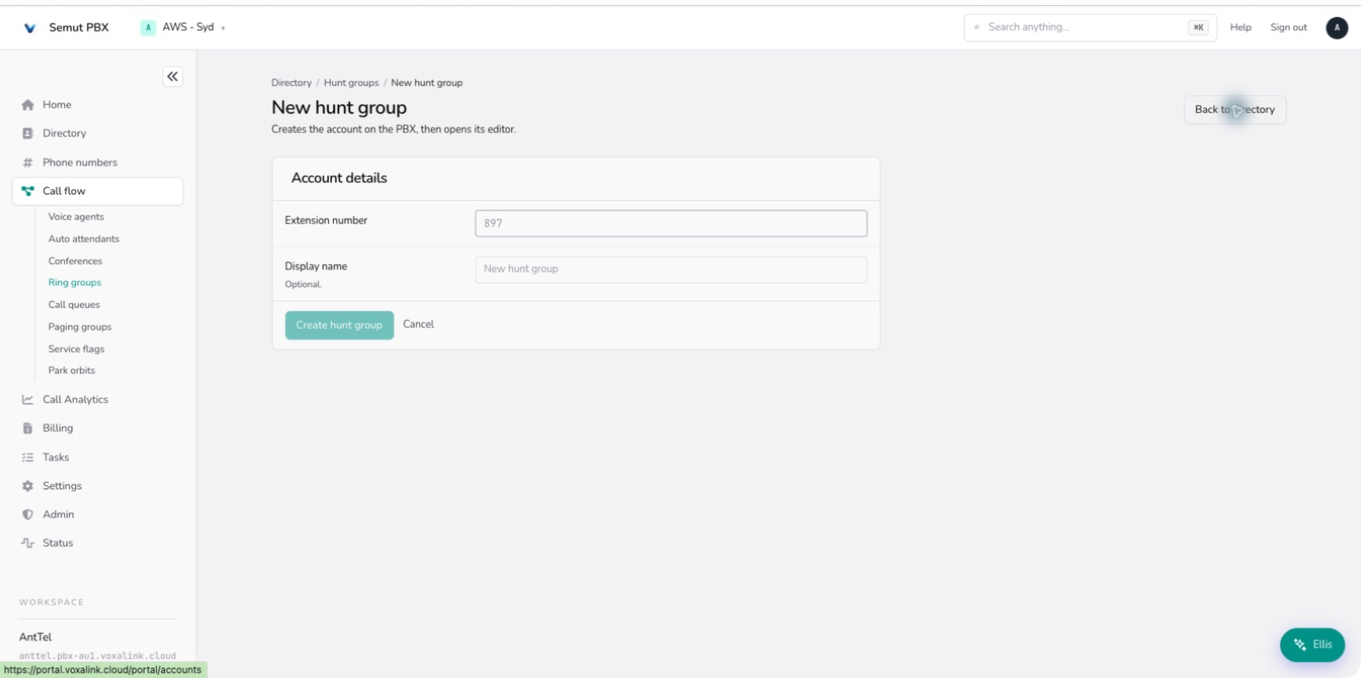
On the Call flow page (Routing & call handling), open the Ring groups card and choose New. Give it an account number (the internal number that reaches it) and a name, then point an external number at it from Phone numbers. Open the group and work through the Edit tab.
The Edit tab
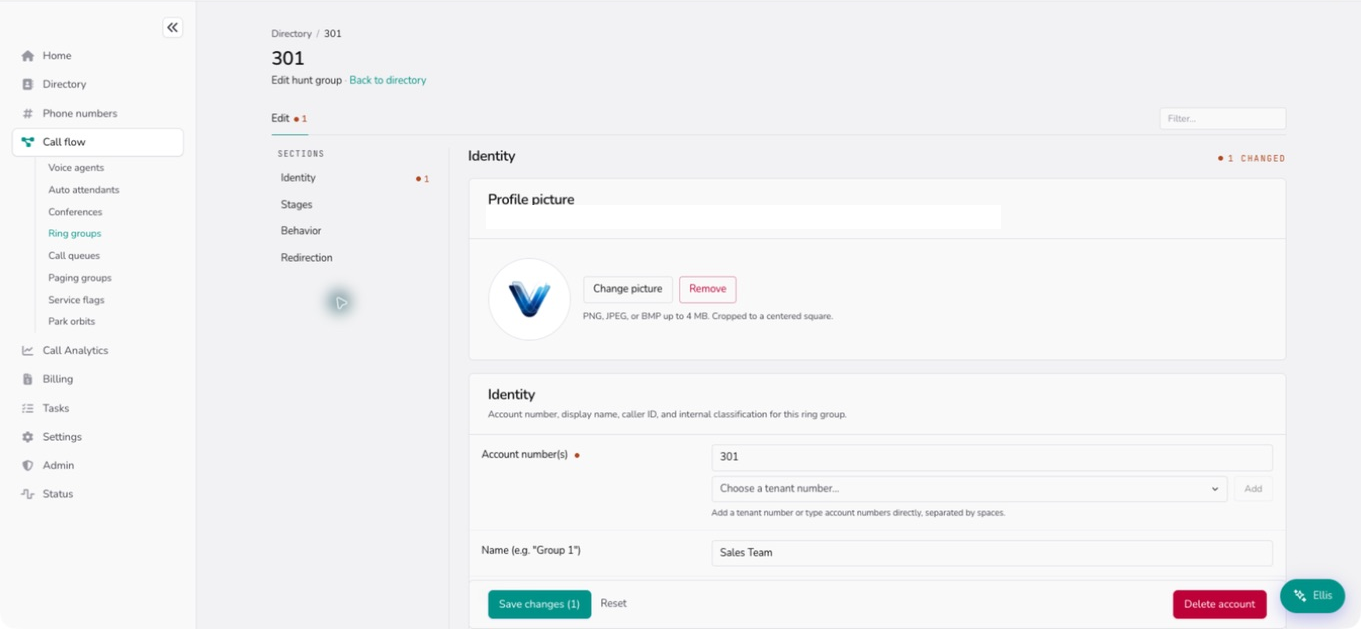
The sections run down the left rail.
Identity
- Account number(s) — the number(s) callers dial to reach the group; separate several with semicolons.
- Name / Short name — the full name (admin lists), and a short version for cramped phone soft-labels.
- Pronunciation — how text-to-speech should say the name.
- Caller ID — the outbound caller-ID shown when the group routes a call to an external number.
- Account class name — an optional billing/reporting tag.
- Note field — admin-only notes; the system ignores it.
Stages
Who rings, and in what order. Stages 1, 2 and 3 each have:
- Extensions — the phones rung at this stage; separate several with semicolons.
- Duration — how many seconds this stage rings before moving to the next.
- Flag missed — whether an unanswered ring at this stage is recorded as a missed call.
The final stage takes a last set of extensions to try. Add more phones to later stages so a call that isn't answered up front widens to a bigger group.
Behavior
How the group treats the call and its members.
- Algorithm — how members within a stage are rung (for example all at once, or spreading calls to the most-idle member first).
- Ring melody for direct call to extension — a distinctive ringtone so members can tell group calls apart from their own direct calls.
- From-header — the caller information shown on members' phones when a group call rings, so they know which line to answer.
- Dial plan for outbound calls — the rules used when the group routes a call to a non-extension destination.
- Page incoming calls — announce arriving calls over a paging group.
- Announcement while ringing / Number of rings before announcement — play a message to the caller while the group's phones ring, after a set number of rings.
- Music on hold source / Ringback source — the music a held caller hears, and what the caller hears while the group's phones ring.
- Record incoming calls to ring group — the recording / transcription policy for calls hunted through this group (inherit the tenant default, record audio, transcribe, or both). See Call Analytics.
- Send daily CDR report to / at / Send nightly CDRs as — email a call-detail report to an address, at a set time, as a table or a graphical report.
- Send email about missed calls to — notify an address whenever a group call goes unanswered.
- CRM account — the CRM to attribute the group's calls to.
- Redirect destination for suspected SPAM calls (with threshold and anonymous-caller score) — where to send, and when to reject, calls the PBX flags as spam.
Redirection
A night-mode destination: a number that calls divert to instead of ringing the group — the usual way to send after-hours calls to voicemail or an answering service. Pair it with a service flag for your opening hours.
A worked example — reception team
A small office wants every reception call to ring the two front-desk phones first, pull in the office manager if nobody answers, and fall back to voicemail — all on one number.
- Create the group from Call flow → Ring groups → New as account
600, and point the main number at it from Phone numbers. - Stage 1 = the two reception phones (say
501; 502), with a duration of ~15 seconds and Flag missed on. - Stage 2 = add the office manager (
510) so a missed reception call widens to the manager. - Final stage → the shared mailbox (e.g.
8600) so nothing is lost. - Show the line with a From-header that includes the group name, so a ringing phone reads "Reception" and staff know to answer it that way.
- After hours → voicemail by setting the Redirection night-mode destination to the mailbox, paired with your office-hours service flag.
Everyday tasks
- Ring a team on one number → Call flow → Ring groups → New; put the team in Stage 1, point a number at it.
- Escalate when nobody answers → add phones to Stage 2/3 and the final stage.
- Tell group calls apart from direct calls → set a Ring melody and a From-header that shows the group name.
- Send after-hours calls to voicemail → set the Redirection night-mode destination, paired with a service flag.
- Hold callers in line instead → if calls should wait rather than ring out, use a call queue.