
Settings
Tenant-wide defaults — identity, caller IDs, voicemail, music on hold, permission groups, and shared audio — that everything else inherits from.
Settings holds the tenant-wide defaults: the values an individual extension, queue, or auto attendant uses unless it overrides them. Set something here and it applies everywhere that has not been given its own value. It has a main General page plus a handful of focused sub-pages down the left.
General
The everyday tenant basics. It is one long page split into sections (jump between them with the on-page links).
Identity
- Name of this tenant — the descriptive name shown in system emails and the portal title bar.
- Default dial plan — the dial plan applied to outbound calls when an extension has not picked its own (Phone numbers).
- Timezone — used for schedules, CDR timestamps, and time-of-day routing across the tenant.
- Default location — the physical location applied to extensions without their own.
Language & locale
- Default IVR language — the language used for system prompts, the web UI, and dial tones.
- The country whose ringback, busy, and dial tones callers hear.
Music & ringback
- Music on hold source — the default audio played to callers on hold.
- Ringback source / Ringback when busy — what the caller hears while a destination rings, or when it is busy.
- Ring melodies — default melodies for direct calls, added extensions, and transfers.
Caller ID
- Default ANI — the caller ID presented outbound when an extension has none of its own.
- Extensions may use star code to change ANI — whether users can override their presented number.
- Trust caller-ID — treat inbound caller ID as authentication; enable only on a trusted trunk.
- From-header and P-Asserted-Identity — the SIP header formats used on outbound calls.
Emergency
- Caller ID for emergency calls — the number presented when an extension dials an emergency service.
- Paging account for emergency call notifications and the audio file played — so staff are alerted when someone places an emergency call.
FAX & SMS
- Caller ID for FAX and FAX header text burned into outgoing pages.
- Default number for interactive text messages and the number for automatic text messages — the sender numbers for two-way and one-way SMS.
Mobile phone schedule
- When the PBX may ring an extension's mobile phone, per day of the week.
- Show extension mobile phone numbers to users — whether mobiles appear in the directory.
Call handling
Tenant defaults for DND (default duration, maximum ring duration, classroom DND control/override), park reminder and transfer reminder timing, camp-on, and the attended transfer tone.
Calendars
Connect Google Calendar or Microsoft Outlook/365 accounts at the tenant level — once connected, voice agents can check availability and book into the calendars you choose, and service flags can pull holiday events from them. A connected account shows its email address, provider, and status (Connected, or Reconnect needed if access has expired) — use Refresh to re-list its calendars after adding one on the provider's side, or Disconnect to remove it (with a confirmation step, since anything using that connection will stop working). Connecting is a one-click OAuth sign-in with the provider; nothing else to configure here.
Google Contact
- Google contacts client ID and client secret — the OAuth credentials used for Google contacts sync.
Other
Less-common toggles shipped with new tenants — for example don't log calls to star codes and send a welcome email when an extension is created.
Address book
The tenant's shared address book — contacts that appear on extensions' phones and apps (alongside each extension's local entries). Whether a given extension shows these is controlled per person under General → Address book (Directory).
Voicemail
Tenant-wide voicemail defaults — the baseline every mailbox inherits unless the extension overrides it (Directory). Sections:
Mailbox sizing & retention
- Time until the mailbox picks up — default ring time before voicemail.
- Compress mailbox messages — GSM compression to save storage at a slight quality cost.
- Default message caps and retention.
PIN
The tenant PIN policy for voicemail access — length and rules for the codes users dial in with.
Behaviour
- Mailbox escape account — where callers go if they press 0 in a greeting.
- Mailbox direct dial prefix — a prefix that jumps straight to a mailbox without ringing through.
- Alternative numbers for reaching the mailbox and an external voicemail system option (forward to, e.g., Microsoft Exchange instead of the built-in mailbox).
- Call forward on no answer timeout — default ring-before-voicemail behaviour.
Fax (T.38)
Tenant defaults for fax-over-T.38 handling.
Voice to text
Tenant default for voicemail transcription (speech-to-text of messages).
Feature codes
The voicemail feature/star codes users dial to check and manage messages.
Groups
Permission groups and their membership. Each group governs what its members can do — BLF visibility, call pickup, app access, and the rest of the permission set you saw on the extension's Permission tab (Directory). The list shows each group's Name and Members; + New group creates one, and Edit opens it. Because permissions are group-based, this is where you define a capability once and apply it to many people by membership.
Appearance
Brand the tenant's web interface and generate correctly-sized wallpaper images for provisioned desk phones.
- Web-interface logos — upload a light-background and a dark-background logo, shown across the portal depending on the viewer's theme.
- Phone background generator — pick the scope (a single extension or a whole model range), choose a light and dark background composition, then generate & upload — the tool renders correctly-sized wallpapers for each supported phone model automatically, with per-model previews before you push them out.
Music on hold
Manage the music-on-hold audio for the tenant — the source(s) callers hear while waiting. Extensions and queues can point at a specific source, or fall back to the tenant default set under General → Music & ringback.
Audio library
Upload and manage the tenant's audio files — greetings, prompts, and announcements used by auto attendants, queues, and mailboxes. Upload a file here once and reference it wherever a prompt is needed across Call flow.
LLM
This is where you switch on VoxaLink's AI features — the written summary on each call (see Call Analytics › AI call summary), the AI Briefing on your Home dashboard, and the writing help in the Voice Agent editor. They do not run on a VoxaLink AI account: you bring your own. In the portal it lives under Settings → General → LLM.
"Bring your own" means you open an account with an AI company, get a key from them (a long secret, like a password), and paste it in here. VoxaLink then uses that key on your behalf, and the AI company bills you directly for what you use. Until a key is connected, these AI features stay switched off. It sounds technical, but it is really three fields and a couple of clicks — the walk-through below covers it.
You need to be an administrator
Only a tenant administrator can change these settings. If your tenant is looked after by a reseller, this section is read-only and simply shows a note telling you who to contact — they hold the AI settings for you.
Connect an AI provider
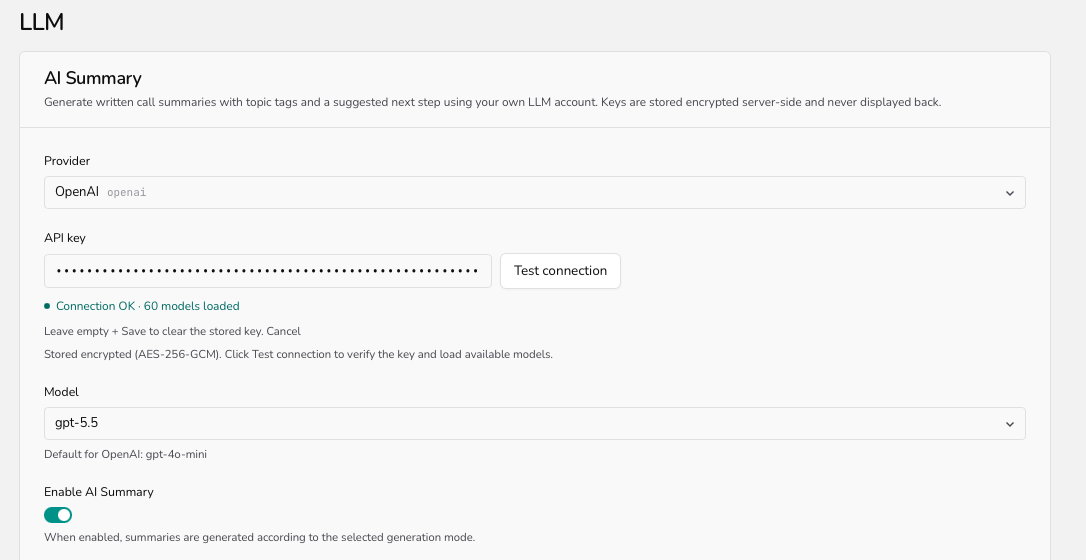
Step 1 — pick a provider. Choose the AI company you want from the Provider dropdown:
- OpenAI — the makers of ChatGPT.
- Anthropic (Claude) — the makers of Claude.
- Google Gemini — Google's AI.
Any of them work for call summaries. AI Briefing works with OpenAI and Anthropic only for now — so if the dashboard briefing is what you are after, pick one of those two. You get the key from your chosen provider's website (look for their "API keys" or developer page); you only do this once.
Step 2 — paste your key and test it. Paste the key into the API key box (it is hidden as you type, like a password), then click Test connection:
- A green Connection OK means the key works — VoxaLink also loads the list of AI models your account can use, ready for the next step.
- A red message means the key was rejected — usually a typo, a stray space, or a key from a different provider. Fix it and test again.
Your key is kept private
The key is encrypted before it is stored and is never shown back to you — once saved, the box just shows dots and a Replace button. VoxaLink staff cannot read it either. Only your usage (how much you have spent) is recorded — never the key, and never the content of your calls.
Step 3 — choose a model. The Model box selects which version of the AI to use. After a successful test it becomes a dropdown of the models available to your key. If you are unsure, leave it on the suggested default for your provider — it is a sensible, low-cost choice.
Step 4 — turn it on. Switch Enable AI Summary on (it stays greyed out until a key is saved, so add the key first, then come back to it) and click Save. AI features are now live for your tenant.
Keeping costs under control
Because the AI provider bills you directly, VoxaLink gives you controls so there are no surprises:
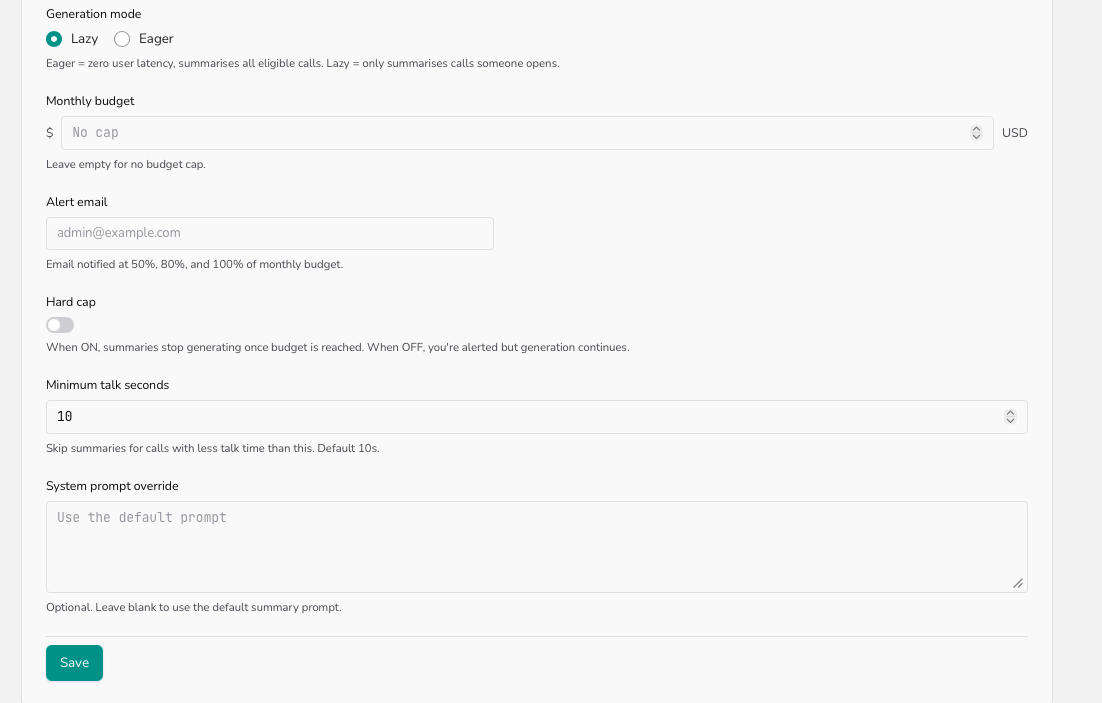
- Generation mode — Lazy (recommended) only writes a summary for a call when someone actually opens it, so you pay only for what you read. Eager summarises every eligible call automatically the moment it ends — nothing to wait for when you open a call, but you pay for all of them.
- Monthly budget — an optional dollar limit for the month. Leave it blank for no limit.
- Alert email — the address that gets a heads-up at 50%, 80%, and 100% of that budget.
- Hard cap — when on, AI stops the instant you hit the budget. When off, you still get the alert emails but AI keeps running. Turn it on if you never want to go over.
- Minimum talk seconds — skips summarising very short calls (default 10 seconds), since a three-second call has nothing worth summarising.
- System prompt override — advanced, and safe to ignore. It lets you reword the instructions the AI is given for call summaries; leave it blank to use VoxaLink's default.
Watching your spend
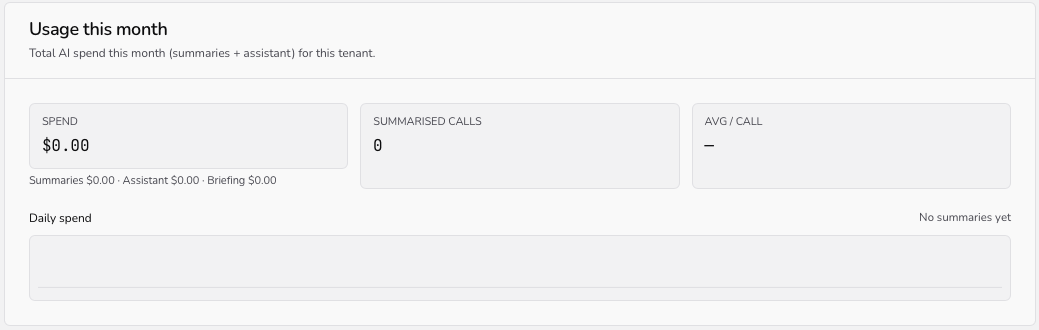
Below the settings, the Usage this month panel shows what you have spent so far — split across summaries, the assistant, and briefings — how many calls were summarised, the average cost per call, and a small day-by-day chart. It is the quick way to check everything is behaving and staying within budget.
Which features need which provider
- Call summaries (Call Analytics › AI call summary) — any provider (OpenAI, Anthropic, or Google Gemini).
- AI Briefing — OpenAI or Anthropic only (Google Gemini is not supported for briefings yet).
- Voice Agent writing help — uses the same connected provider.
Everyday tasks
- Rename the tenant / set the timezone → General → Identity.
- Change the default hold music → General → Music & ringback, or manage sources under Music on hold.
- Set the emergency caller ID → General → Emergency (and per-extension under Directory).
- Tighten the voicemail PIN policy → Voicemail → PIN.
- Give a set of people the same permissions → Groups, edit membership.
- Add a greeting you can reuse → Audio library, upload it, then pick it in the relevant auto attendant or queue.
- Connect a calendar for voice agents or holiday sync → General → Calendars.
- Upload your logo or brand a phone's wallpaper → Appearance.
- Turn on AI features (call summaries + AI Briefing) → LLM, connect a provider.
Next: Admin — the technical plumbing: devices, webhooks, locations, and integrations.