
Directory
The people on your phone system — adding them, and a complete, field-by-field reference for every tab of the extension editor.
The Directory is the list of people on your phone system. In telephony terms each person is an extension — an internal number that can register a desk phone or the mobile app, make and take calls, and own a voicemail box. Almost everything else in the portal points back here: a phone number routes to an extension, a ring group contains extensions, a call report is about extensions.
This is the chapter you will return to most, so it is the most thorough. It opens with the People list and adding someone, then documents the extension editor one tab at a time, field by field.
The People list
Open Directory and you land on People — every account on the tenant, one per row, showing the person's name, email, how many devices are registered, their live status, and when they were last seen. Click any row to open that person's editor.
Across the top:
- Search — filter the list by name, email, or extension number.
- Status tabs — All, Available, On a call, Offline, and Devices unregistered. The last is the fastest way to spot a phone that should be working but has not registered.
- Import CSV — bulk-create people from a spreadsheet.
- + Add a person — create a single new extension.
License capacity and account types
Above the list, the License capacity panel shows how many of each account type you have assigned versus how many remain. Capacity is counted once an account is saved, so a type only consumes a license after the account exists. Choose the right type when you create a person — it determines which features the account can use:
| Type | What it is for |
|---|---|
| Regular | A standard user — desk phone and/or mobile app, voicemail, the full feature set. The everyday extension. |
| Residential | A lightweight line for a simple endpoint, with fewer features — typically a single device. |
| Mailbox | A voicemail box with no live device — an inbox that only ever takes messages. |
| Agent | A queue-agent seat — required for anyone who answers calls in an ACD queue (see Call flow). Only Agent accounts can log in to a queue and take its calls. |
| Hot desk | A shared-desk profile — a user logs in at any physical phone and their identity follows them to it. |
One constraint to know when planning queues: only accounts created with the Agent type can log in to a call queue and take its calls. A Regular extension can be added to a queue's agent list, but it will not serve the queue.
If you are out of a type, free one up (delete an unused account) or have more licensed before creating another.
Adding and importing people
Click + Add a person for a blank extension editor. At minimum, set the person's name, account number (the extension others dial), password, and PIN, then Save changes — the account is created and starts consuming a license. Everything else can be filled in now or later. The editor is identical whether you are creating or editing, so the tab-by-tab reference below applies to both.
To set up many people at once, use Import CSV and provide one row per person.
The extension editor
Click a person to open their editor. The header shows their name, presence, extension number, registered-device count, and last-active time. Two controls live here:
- User Mode — jump into this person's own user-portal view, to see exactly what they see or to set something up for them. What they may change for themselves is governed by the User Page Field Control tab (below).
- The action bar at the bottom — Save changes, Reset, Delete account — behaves as in Getting around: nothing is applied until you save.
Settings are grouped into ten tabs. The Filter box beside the tabs finds a setting by name; busier tabs add a Sections list down the left, and the What this means rail on the right previews the effect of your changes in plain English.
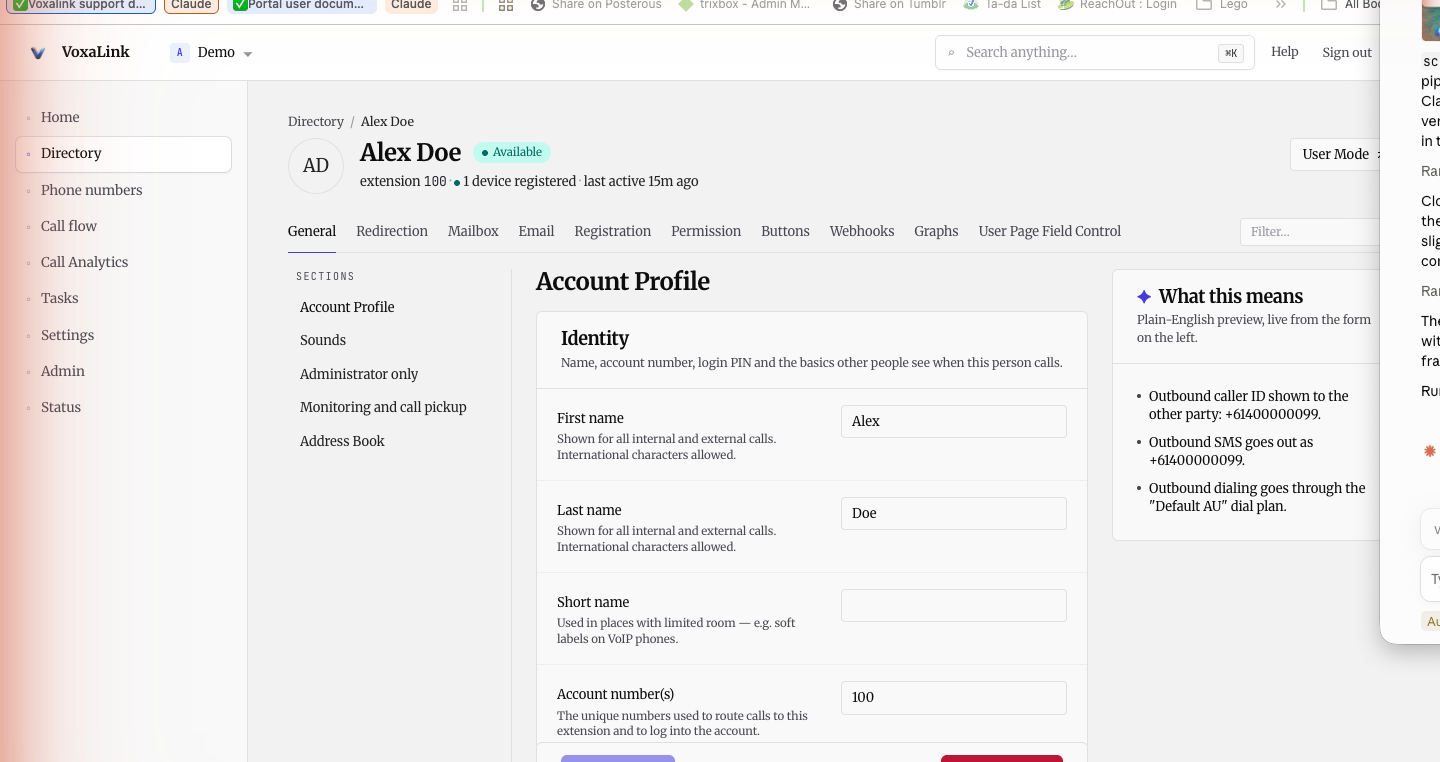
General
Identity and day-to-day basics, in five sections.
Account profile
- First name / Last name — shown on internal and external calls; international characters allowed.
- Short name — a compact label for places with little room, such as the soft-key labels on a desk phone.
- Account number(s) — the unique number(s) used to route calls to this extension and to sign in. This is what people dial.
- Password — used for both the phone's SIP registration and the user's web sign-in. At least 8 characters with one uppercase letter and one number; passwords from the account's history cannot be reused.
- PIN — 3–6 digits, for checking voicemail from outside, calling-card access, and hot-desking.
- Timezone — sets the time reference for voicemail timestamps and anything else time-related on this extension; can inherit from the tenant.
Sounds
- Music on hold source — a per-extension hold source that overrides the tenant-wide music on hold (see Settings) when set.
- Ringback source — what the caller hears while this extension is ringing.
- Ringback when busy — what the caller hears when the extension is already on another call.
- Ring melody — a distinct ringtone so the user can tell direct calls, transfers, and ring-group calls apart by ear.
Administrator only
Controls that belong to you, the administrator — not the user.
- License type — the feature bundle for this extension (defines which services and licensed features it can use).
- Account class name — a tag for grouping extensions for reporting and per-class settings.
- Dial plan — the outbound routing rules for calls from this extension. Leave on the domain default unless you need to override it (dial plans are covered in Phone numbers).
- Caller ID — the number(s) this extension is allowed to present as caller ID on outbound calls.
- Caller ID for emergency calls — the single number presented when this extension dials emergency services. Set this correctly per location.
- Sender ID for text messages — the SMS-capable DID used as the from-number for outbound texts.
- FAX routing — the DID that routes inbound fax calls to this extension.
- FAX header text — the text printed across the top of every outbound fax page.
- Send daily CDR report to — recipients of the daily call-detail-record summary email (press Enter to add each;
Name <email>for a display name). - Send daily CDR report at — when that email goes out, to 15-minute granularity; leave the day on Every day for a daily report.
- Number of queues this extension can log into — a cap on simultaneous queue logins; Unlimited removes it.
- After login navigate to page — where the user lands after signing in to the front-end (mainly for queue supervisors).
- Maximum call duration — a hard limit on how long a single call from this extension can run before the system ends it.
Monitoring and call pickup
- Explicitly specify pickup preference — which other extensions may pick up this person's ringing calls.
- Explicitly specify park orbit preference — which park orbits this person may pick up from.
Use these to let a team cover each other's phones.
Address book
- Address book visibility — whether shared and local address-book entries appear on this extension's phone and app; can inherit from the tenant.
- Include accounts in the phone address book — whether other accounts are listed in the phone's address book.
Redirection
Everything about sending calls somewhere other than this phone — in four sections.
Redirection
- Do not disturb (DND) — the master accept/reject switch. When on, every caller goes straight to voicemail or the configured DND target.
- Default duration for DND — auto-clears DND after this long; No automatic reset keeps it on until toggled off by hand.
- Hot desking → Hot Desking at — borrow this person's identity at another desk; pick the extension that should receive their calls while they are logged in there.
- Hand off to a group → Call forward to group — forward incoming calls to a hunt group (hunt-group accounts only), or disconnect with busy when this extension is already on a call.
- Allowed forward targets → Forward destinations — limit which numbers the user may choose when forwarding from the app or user portal; Disabled removes their ability to set forwards at all.
- Call forwarding — where calls go, by condition:
- All calls — unconditional; every inbound call is redirected here.
- When busy — used when the extension is already on a call.
- No answer, with No answer timeout — where the call goes if no one answers, and how long to ring first.
- Not registered — where the call goes when no device is registered.
- Ring others too → Also ring these extensions — ring a list of other extensions in parallel, either always or only when this one is busy.
Mobile phone numbers
- Mobile phone numbers — space-separated list of mobile numbers, used for both outbound caller matching and inbound mobile bridging.
- Mobile phone numbers (inbound only) — numbers that may call the PBX as this user but are never dialled outbound.
- Numbers that will never get to the mobile phone — caller numbers that will not bridge to the mobile (useful for blocking).
- Numbers that will always ring the mobile phone — caller numbers that always bridge, even outside the configured schedule.
- Offer special menu when call is answered on mobile — plays a press-key menu before the mobile leg connects, so the user can accept or decline.
- Initiate call back after hangup — the PBX calls the mobile straight back after a hangup, so the user can return a call without paying for the outbound leg.
- When calling the extension directly — whether, and after how many seconds of the desk phone ringing, the mobile leg also rings.
Disable device types
Stop calls ringing on specific device types — for example, mute the desk phone but keep the mobile app ringing.
Recording
Per-extension call-recording behaviour for this person's calls.
Mailbox
The person's voicemail, in four sections (Mailbox, Prompts, Source, Recordings) covering everything from basic behaviour to greetings.
Mailbox basics
- Mailbox enabled — the master switch. Setting it to FAX turns the extension into a fax-receiving endpoint instead of a voicemail box.
- Time until mailbox picks up — how long inbound calls ring before going to the mailbox.
- Maximum number of messages — a cap on stored messages; set to 0 to play the greeting but record nothing.
- Send warning when mailbox gets full — triggers a warning email at a chosen fill level, expressed either as percent-full or as remaining free slots.
- Automatic deletion of messages — how long the system keeps messages before auto-deleting them (retention).
- Mailbox explanation prompt — whether to play the "leave a message after the tone" explanation even when the user has recorded a personal greeting.
Cell phone notification
Notify the user's mobile when a new message lands, so they know to check voicemail without being at their desk.
Escalate to a supervisor
- Call supervisor when message was not retrieved — if a message stays unread past this delay, ring a chain of supervisors until someone picks it up. Useful for mailboxes where missed messages matter (sales, support).
Sharing & delegation
- Mailbox escape account — where a caller goes if they press 0 while listening to the greeting; overrides the domain default.
- Allow access to agents of ACDs and ring groups — lets agents of the listed queues / hunt groups read this mailbox without an explicit shared-access entry.
- Copy new messages into the following mailboxes — sends a copy of every new message to other mailboxes (good for shared inboxes).
- Make messages available in the following mailboxes — grants other users read access to this mailbox without copying the messages.
Listening experience
- Enable voicemail to text API — sends each new message to the configured speech-to-text engine and emails the transcript.
- Plus options for what the user hears when entering and retrieving messages.
Fax over T.38
How the PBX negotiates the T.38 protocol when this mailbox receives or sends fax.
Greetings (Prompts)
The Mailbox prompts section chooses which recording plays in each situation:
- General greeting — up to five greeting slots (Greeting 1–5) to rotate or choose between.
- Greeting when on do not disturb.
- Greeting when in another call.
- Greeting when out of office hours.
- Name presentation in mailbox and in auto attendant — how the person's recorded name is spoken in those contexts.
Greeting source (Source)
For each greeting slot, the Greeting source section is where you provide the audio — record it, upload a file, or generate it from text with text-to-speech. Star codes for recording from a phone are shown here too.
Recordings
Access to the actual recorded messages and greeting audio held for this mailbox.
How voicemail and activity reach the person by email — three sections.
Voicemail by email
- Email addresses for extension — semicolon-separated list that receives this extension's notifications. Press Enter to add each; use
Name <email>for a display name. - Send a mailbox message by email — whether voicemails are emailed, and in what form (for example, the audio attached, or a link).
- After sending a message — what happens to the voicemail in the mailbox afterwards (kept, marked read, or removed).
Activity notifications
- Send email on missed calls — a notification whenever a call goes unanswered.
- Send email at the end of every call — a CDR-style email for every completed call.
- Send email on status changes — whenever the extension registers or unregisters.
- Send email when mailbox is full, and notifications for blocked callers.
Recordings & messaging
Delivery of call recordings and related messages by email.
Registration
How phones and apps connect to this extension — three sections.
User agent setup
- Mobile App Login → Show Login QR Code — generates a one-tap QR code to sign the VoxaLink mobile app into this extension.
- Enable multiple mobile phone registrations — lets the same extension run in the app on more than one device at once (e.g. phone + tablet).
- Trusted IP address — a single IP that may register or place calls without authenticating. Use sparingly — typically an on-prem gateway.
- Accept ## to hold call — lets the user press
##mid-call to hold; off by default to avoid surprising users on older handsets. - Lines — how many simultaneous call legs (line appearances) the extension supports; 0 uses the device default.
- Max. number of concurrent registrations per extension — caps how many devices may register this extension at once.
- Addresses that can start calls without authentication — IPs allowed to trigger click-to-dial without credentials; pair only with a trusted internal CRM.
- General codec preference — the ordered codec list offered for desk-phone and SIP-trunk calls; drag to reorder, or leave empty for the domain default.
- Codec preference for mobile apps — codec ordering for the mobile/WebRTC client; usually lead with Opus for cellular resilience.
- Log registration changes — how verbosely the system journals registration events for this extension, from off up to all events or email digests.
Registrations
A live table of devices and apps currently registered against this extension — contact, transport, push token, and last-seen time, with a Refresh.
Registration History
The audit trail of past registrations — the place to look when a phone keeps dropping off.
Permission
What this account is allowed to do. Permissions are group-based: the effective set comes from the group(s) the account belongs to, and when two groups conflict, the one with the higher Priority wins. You can Remove the account from a group here. The available permissions include:
- Call mobile phone — bridge calls to the user's mobile.
- BLF view only — appear on others' busy-lamp-field keys (presence visible).
- BLF view and pickup — as above, plus allow remote pickup of the monitored line.
- Enable web frontend — allow sign-in to the web portal.
- Enable app use — allow the mobile app.
- After-hours recording — permit recording outside office hours.
- Paging — allow this extension to page.
- Manage service flags — allow toggling service flags (see Call flow).
Editing the rules inside a group is done in the underlying PBX admin interface, not this screen — our portal manages group membership and shows the effective result. Groups are covered in Settings.
Buttons
The programmable keys (BLF / busy-lamp-field and speed dials) on the person's desk phone. Buttons are configured per device, so this tab stays empty until a phone is enrolled — "enroll a phone via Provisioning to configure buttons." Once a device is provisioned, assign what each key does here. Provisioning lives in Admin.
Webhooks
Per-extension webhooks — outbound HTTP calls fired when something happens on this extension, so other systems can react in real time. Each event is off by default; switch on the ones you need and give each a URL. They are grouped by type:
- Call lifecycle — When a new call comes in, When a call is answered, When a call ends (CDR) — the per-call firehose.
- Presence & emergency — When DND is enabled, When DND is cleared, When an emergency call is placed.
- Hospitality — When a wake-up call fires, …is missed, …is cleared, and When a hotel room is cleaned — for room-management features.
- Mailbox events — When a new mailbox message arrives.
Tenant-wide webhooks (not tied to one extension) live under Admin.
Graphs
A visual history of this extension's activity over the last 24 hours in 6-minute buckets, newest on the right:
- Calls — call volume over time.
- Registrations / Subscriptions — how many devices were registered.
- Registration changes — adds and removes, useful for spotting a flapping device.
- Call Quality (MOS) — mean opinion score for recent calls, rendered server-side. Shows "no data" until this extension has scored calls.
User Page Field Control
This tab decides which features and fields the person can see and change in their own user portal (the User Mode view). It is what makes User Mode safe to hand to an end user — expose what they should self-manage, hide or lock the rest. Controls are grouped to mirror the user portal:
- App settings — leads with Offer AI assistant: whether this person can see and manage the AI Assistant in the VoxaLink mobile app. Unlike the rest of this tab it saves the moment you flip it, and turning it off deletes any assistants they have configured — this cannot be undone. The rest of the group covers mobile/web app visibility: which extensions they see, whether they see all users' calls, whether they can start new calls (click-to-dial), home-screen content, and whether to offer video, chat/sms, and fax. Offer chat/sms also decides whether Messages appears in this person's VoxaLink mobile app — force it off to hide texting for just this person.
- Features — do not disturb (including expiry, reason, and forward) and starting new calls.
- Call Forwarding — whether the forwarding section is shown, and which of forward-all / forward-busy / forward-no-answer they can set, each with numbers and time conditions.
- Mailbox, Account Profile, Profile picture, Preferences — whether the user can view and edit each.
- Device selection, Notifications, Desktop phone buttons, Mobile phone numbers, Tokens and Passkeys — per-area visibility.
- CRM Settings (including Google and ActiveSync) and Monitoring and call pickup — whether these appear in the user portal.
Everyday tasks
A few common jobs and where each lives:
- Add someone new → + Add a person; set name, account number, password, PIN; Save.
- Give someone a desk phone → create the person, provision the device (see Admin), then set keys under Buttons.
- Ring a person's mobile alongside their desk → Redirection → Mobile phone numbers, set the number and the When calling the extension directly delay.
- Turn on voicemail-to-email → Email → Voicemail by email, add the address and choose the form.
- Read voicemail as text → Mailbox → Listening experience → Enable voicemail to text API.
- Share a mailbox with a team → Mailbox → Sharing & delegation, copy or grant access to other mailboxes.
- Let a team pick up each other's calls → General → Monitoring and call pickup.
- Let a user manage their own forwarding → User Page Field Control → Call Forwarding, expose the fields.
- Hide Messages/texting in the mobile app for one person → User Page Field Control → App settings → Offer chat/sms, force it off.
- Turn off the AI Assistant for one person → User Page Field Control → App settings → Offer AI assistant — remember switching it off deletes their configured assistants.
- Stop a phone ringing without losing voicemail → Redirection → Do not disturb, with a target or a timed auto-clear.
- Escalate unread voicemail → Mailbox → Escalate to a supervisor.
Next: Phone numbers — the external numbers that deliver calls to the people you just set up.