
Service flags
Time-based on/off switches that flip greetings and routing into night or holiday mode.
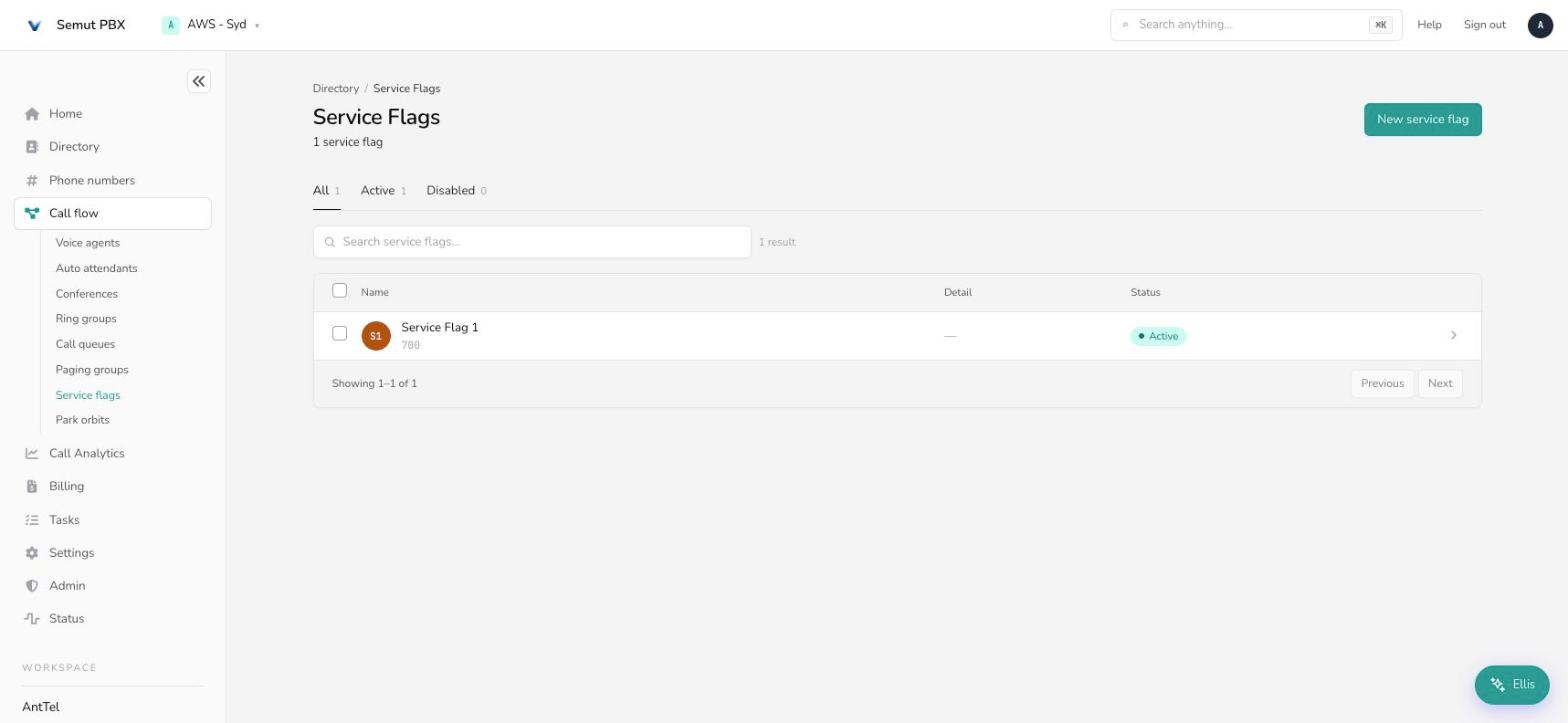
A service flag is a shared, named on/off switch — it doesn't ring or hold anyone by itself, but other call-flow objects can check its state to decide how to route a call. Find them under Call flow → Service flags.
Service flag vs. do-not-disturb Per-extension do-not-disturb is personal — it only affects that one person's incoming calls. A service flag is a shared switch: it can be toggled manually or on a schedule, and any number of auto attendants, ring groups, or call queues can branch on its state at once — the classic use is a single "open hours" flag that every routing object checks to decide day-mode vs. night-mode.
How a service flag works
A service flag has two modes:
- Manual — the flag's state is only changed directly: by an admin, by a permitted extension user, or by dialing the flag's own account number.
- Automatic — the flag computes its own state continuously from a weekly schedule you set (Monday through Sunday time ranges), with Events (holiday dates) able to override the weekly pattern for specific days.
A flag has no destination of its own — it's a pure toggle. To actually route calls differently based on it, pair the flag with an auto attendant or ring group's redirection settings, which check the flag's state.
Anyone can toggle a flag by dialing its account number (optionally gated by a PIN) — there's no separate shared star-code prefix for this; you always dial the specific flag's own extension.
Creating a service flag
On the Call flow page (Routing & call handling), open the Service flags card and choose New. Give it an account number and a name, then open it and work through the Edit tab.
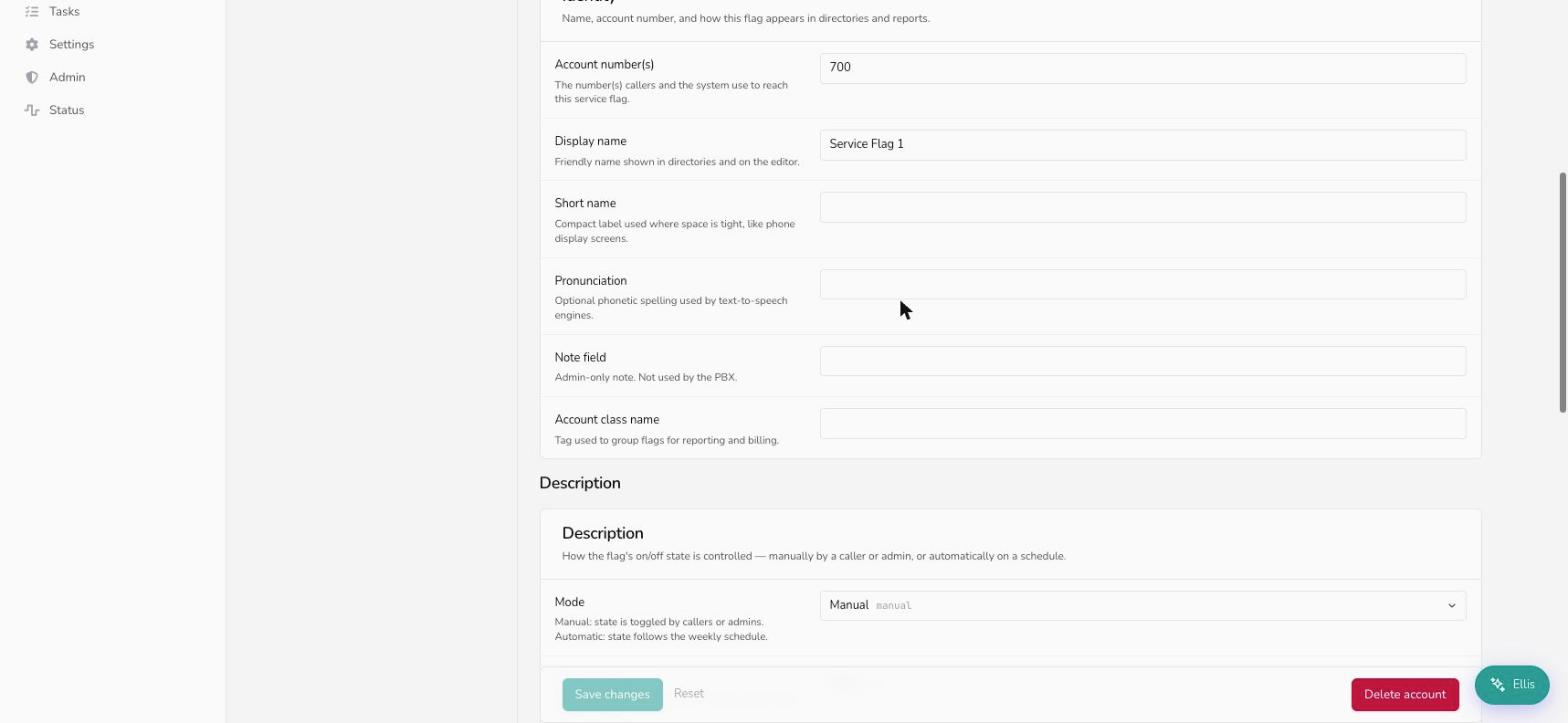
The Edit tab
Identity
- Account number(s) — the number dialed to check or toggle the flag.
- Display name / Short name — the full name (admin lists), and a short version for cramped phone soft-labels.
- Pronunciation — how text-to-speech should say the name.
- Note field — admin-only notes; the system ignores it.
- Account class name — an optional billing/reporting tag.
Description
- Mode — Manual or Automatic, described above.
- Current state — Set or Clear. Only shown in Manual mode, since Automatic mode computes state from the schedule instead.
- Confirmation tone — what a caller hears when dialing in: a beep, a spoken "service active/inactive" message, or a spoken "day/night" message.
- When user calls this service flag — whether dialing in offers a choice to change the state, or just silently toggles it.
- PIN code for changing state — an optional code required before the flag can be toggled by phone.
- Timezone — defaults to the tenant's timezone; override it if this flag's schedule should run on a different one.
Schedule (Automatic mode only)
- Logic — whether the times below mean the flag is active during those hours, or not active during those hours (inverted).
- Monday – Sunday — free-text time ranges for each day, for example
09:00-12:00 13:00-17:00. Leave a day blank for no scheduled hours. - Holiday hours — the schedule applied on any date listed under Events, overriding the weekly pattern for that day.
- Events — the actual list of override dates. No hours listed means "not active" that day;
0:00-24:00means active all day. Leave the year off an entry to have it repeat every year.
Calendar sync
Instead of typing Events in by hand, sync them from a calendar you've already connected under Settings → General → Calendars. Pick the account (a connected Google or Outlook calendar) and the specific calendar on it, then Save & sync.
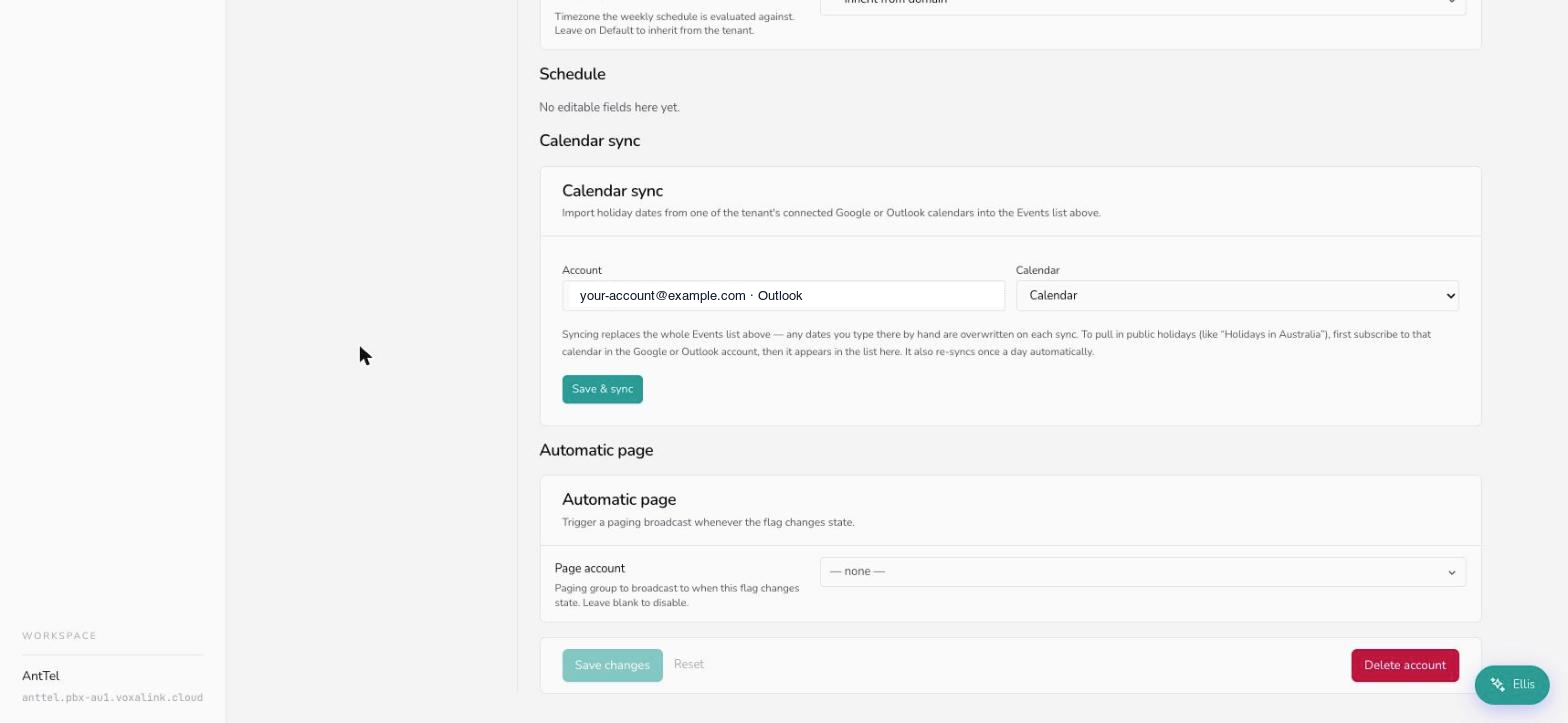
Syncing replaces the whole Events list — anything you typed in by hand is overwritten on each sync, so use one or the other, not both. To pull in public holidays (for example "Holidays in Australia"), first subscribe to that holiday calendar in your Google or Outlook account — once it shows up there, it becomes available to sync here. After the first sync it also re-syncs automatically once a day, so a holiday calendar you subscribe to stays current without any manual upkeep.
Automatic page
- Page account — a paging group to broadcast to automatically whenever this flag changes state. Leave blank to disable.
- Flag that controls the paging — an optional second flag that must also be in the right state for the automatic page to fire.
- Sound at beginning / end — audio played before and after the automatic page. Only shown once a page account is set.
A worked example — office hours switch
An office wants one flag that every routing object checks to decide whether it's currently open.
- Create the flag from Call flow → Service flags → New as account
900, named "Office hours". - Mode → Automatic, with Monday–Friday set to
09:00-17:00and weekends left blank. - Events → either enter the year's public holidays by hand, each with no hours listed so the office reads as closed, or connect a holiday calendar under Calendar sync and let it populate automatically.
- On the main auto attendant, set its redirection to check flag
900: route to the normal daytime menu when active, and to an after-hours voicemail greeting when not. - Every routing object that needs to know "are we open" checks the same flag — update the schedule once, and every dependent object follows it.
Another worked example — business hours to one extension, after hours to another
Say every call to your main number should ring extension 100 during office hours (Monday–Friday, 9am–5pm) and go to extension 101 at any other time.
- Create the flag — Call flow → Service flags → New, for example account
901, named "After hours". - Mode → Automatic, with the right Timezone and Monday–Friday set to
09:00-17:00, weekends left blank. - Logic → "Specify times when flag is not active". The times you entered are your open hours, so this reads: the flag is inactive while you're open and active after hours. (The Logic setting decides which way your times are read — get it wrong and the routing below runs exactly backwards.)
- Point the number at a ring group whose agents include extension
100— during the day, calls simply ring100. - On that ring group's Redirection settings, add one rule: When service flag is active (choose flag
901) → destination101. After hours the flag is active, so calls skip the group and go straight to101. - Test once during office hours and once after:
100should ring in hours,101outside them.
Prefer to think of the flag as "we're open", like the first example? That works too — enter the same times with Logic on "Specify times when flag is active" and use When service flag is not active as the redirection trigger instead. Either way, the rule of thumb is: the times, the Logic setting, and the redirection trigger must agree.
Using the same flag for an AI voice agent: a voice agent's Business hours can follow a service flag, and the agent treats the flag active as after hours — business hours apply while it's inactive. A flag built as in this example (active when closed) drops straight in. See Business hours & escalations.
Everyday tasks
- Ring one extension in hours, another after hours → the worked example above: an Automatic flag plus one redirection rule on a ring group.
- Switch between day and night routing automatically → Automatic mode with a weekly Schedule.
- Close for a specific holiday → add a dated entry to Events with no hours, or connect a holiday calendar under Calendar sync.
- Keep public holidays up to date without manual work → Calendar sync, pointed at a subscribed holiday calendar — it re-syncs daily.
- Let staff flip "we're closed" manually from any phone → Manual mode, dial the flag's account number.
- Require a code before anyone can toggle it → set a PIN code for changing state.
- Announce a status change over the floor automatically → set Automatic page to a paging group.
- Route calls differently based on the flag → pair it with an auto attendant or ring group's redirection settings — the flag itself has no destination.