
Business hours & escalations
When the agent treats calls as in-hours, what it does after hours, and the trigger words that escalate a call immediately.
Two settings sit outside the playbook but change what happens on a call: when the agent treats calls as in-hours, and what jumps the queue regardless of what the caller was asking about.
Business hours
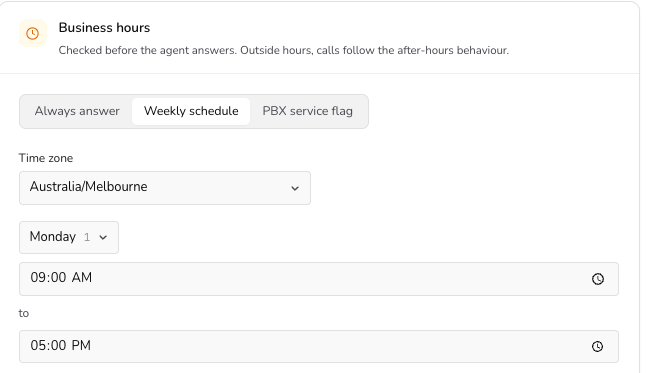
Find these in the Studio under Business hours. There are three modes:
Always on — the agent answers the same way around the clock. Use it when there's no meaningful difference between day and night handling.
A weekly schedule — set a timezone, then opening hours per day. You can add more than one block to a day (a 9–12 and a 2–5, say, for a lunch closure). You can also list holidays — dates that are treated as closed no matter what the weekly pattern says, which is the easy way to handle public holidays and a Christmas shutdown.
A service flag — the agent follows one of your existing service flags instead of its own calendar. The agent treats the flag active as after hours: business hours apply while the flag is inactive. So if the flag's schedule lists your opening hours, set its Logic to "Specify times when flag is not active" — that way it goes active when you close. Use this when you already open and close other call routing with a flag and want the agent to match it exactly — including when someone flips it early or leaves it on through an unplanned closure.
Times follow the timezone you choose, and daylight-saving changes are handled for you.
What happens after hours
Whenever the agent is outside hours (or the service flag says closed), it can speak an announcement first — "Thanks for calling; our office is closed" — and then take one of three actions:
- Transfer the call — send it to an after-hours destination such as an on-call ring group, a voicemail box, or an external number.
- Take a message — collect details and create a task for the morning.
- Read a message & end — say your closing message and hang up.
The announcement is optional; leave it blank if the action itself already says everything the caller needs.
Instant escalations
An escalation rule short-circuits everything else. If certain words come up, the agent stops working through the playbook and acts immediately.
Each rule has:
- A label — what this is, e.g. Emergency, Gas leak, Angry caller.
- Trigger words — words and phrases that fire the rule. Add the natural variations a caller would actually use; matching is on what they say, not an exact phrase.
- An action — transfer the call, take a message, or read a message and end. In practice a transfer to a person is the right answer for anything genuinely urgent.
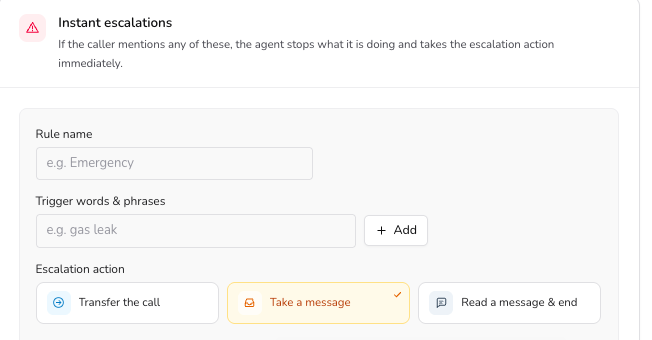
Escalations are checked ahead of the playbook, so a caller who opens with "there's a gas leak" is routed straight away rather than being asked what the call is about. Keep the list short and genuinely urgent — a rule on a common word will pull ordinary calls out of your normal flow.
Good to know
- Both settings are part of the agent's draft until you publish — see Testing & publishing.
- After-hours handling applies to the whole agent. If you want one request handled differently out of hours, escalate or transfer it from the after-hours action rather than duplicating your playbook.
- Booking hours are separate: an appointment row only offers slots inside the availability set on the Calendars page, which is about when you take appointments, not when the agent answers.
Everyday tasks
- Answer differently at night → set Business hours to a weekly schedule and choose an after-hours action.
- Close for a public holiday → add the date to the holidays list; no other change needed.
- Match the agent to how you already open and close → use the service-flag mode.
- Get emergencies to a human immediately → add an escalation rule with a transfer action.
- Stop an escalation firing on ordinary calls → narrow its trigger words to phrases that only appear in a real emergency.