
Auto attendants
The touch-tone menu that answers a call and routes the caller by the key they press or the name they dial.
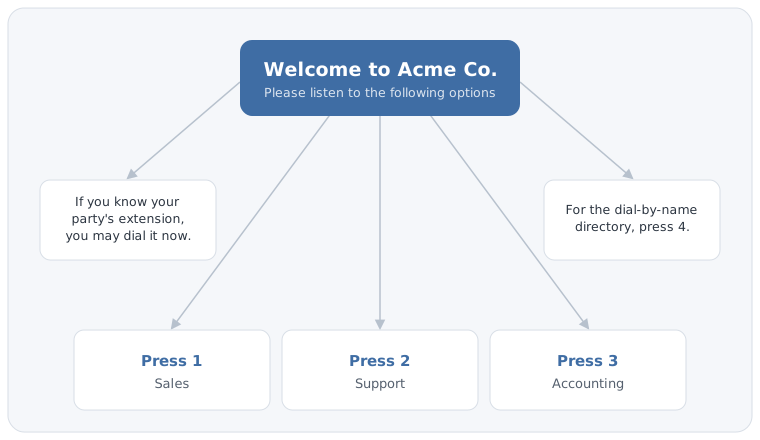
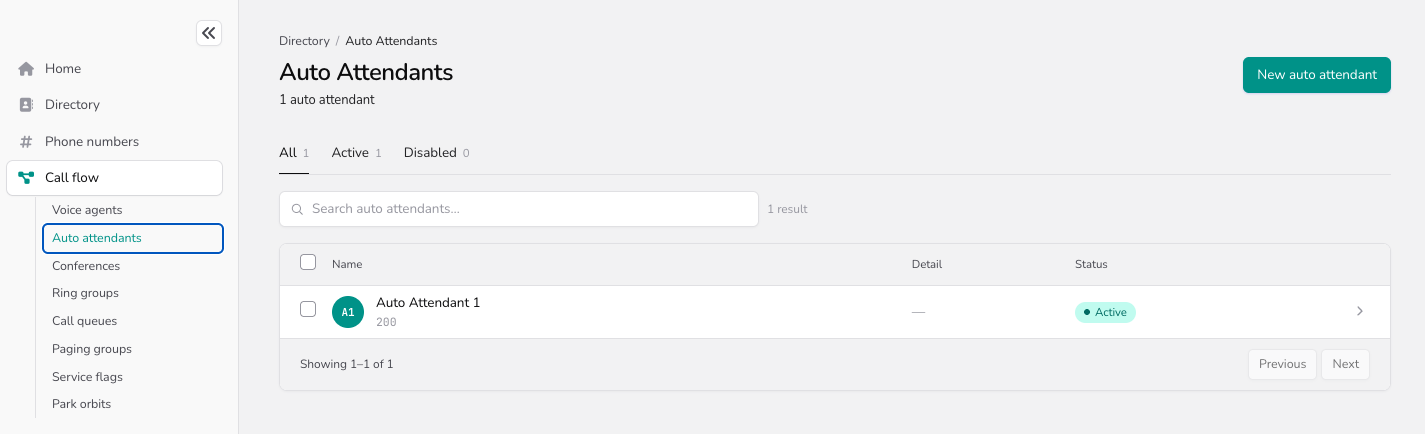
An auto attendant is an automated menu that answers a call, plays a greeting, and routes the caller by the key they press ("press 1 for sales, 2 for support") or the name they dial — the classic front door for a main number. Find them under Call flow → Auto attendants in the portal.
Auto attendant vs. Voice agent
An auto attendant is a fixed touch-tone menu: the caller presses a digit and the call goes where you mapped that digit. If instead you want callers to speak and be routed by what they say, that's a Voice agent (our AI assistant), a separate object on the Call flow page. Reach for an auto attendant when a simple "press 1 / press 2" menu is all you need.
How an auto attendant works
- The attendant answers and plays your welcome greeting.
- The caller presses a key — a direct destination you mapped (press 1 for sales), types an extension number, or presses the key that opens the dial-by-name directory.
- If the caller does nothing, the timeout sends them to a fallback destination (usually a receptionist).
Two things shape most of the settings:
- The menu is a list of keys you map to destinations. You record a greeting that tells callers what each key does, then map those keys under Direct destinations. The options aren't announced automatically — your greeting has to say them.
- Typed extensions and menu keys share the keypad. If "1" is a menu option and extensions start with 1 (101, 102…), they clash. Keeping extensions in the 4xx–7xx range avoids the menu keys.
Creating an auto attendant
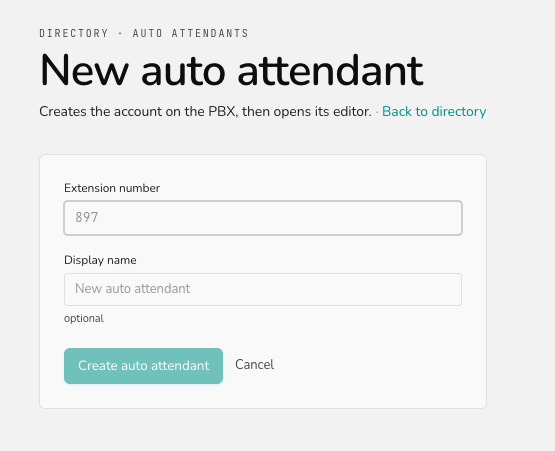
On the Call flow page (Routing & call handling), open the Auto attendants card and choose New. Give it an account number (the internal number that reaches it) and a name, then point an external number at it from Phone numbers. Open the attendant and work through its two tabs — Edit and IVR.
The Edit tab
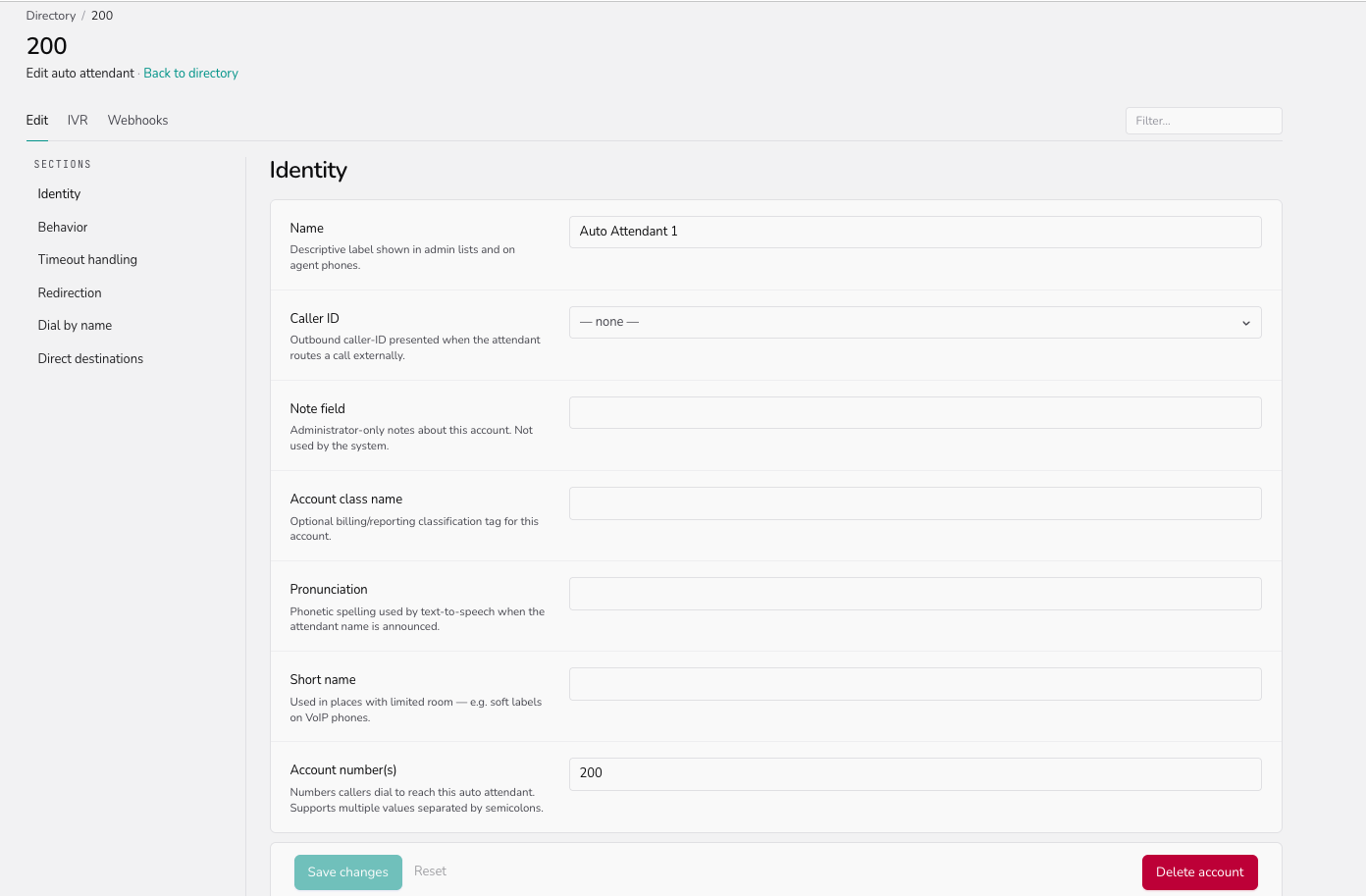
The core configuration. The sections run down the left rail.
Identity
- Account number(s) — the number(s) callers dial to reach the attendant; separate several with semicolons.
- Name / Short name — the full name (admin lists), and a short version for cramped phone soft-labels.
- Pronunciation — how text-to-speech should say the name.
- Caller ID — the outbound caller-ID shown when the attendant routes a call to an external number.
- Account class name — an optional billing/reporting tag.
- Note field — admin-only notes; the system ignores it.
Behavior
- Extension input — when the attendant decides a typed number is complete: match as soon as it matches an extension, after a fixed number of digits, or only when the caller presses
#. - When an extension is dialed, perform the following action — what happens once a valid extension is entered: call the user normally, hot-desk onto it, go to its mailbox, join a conference, or set a wake-up call. Parameter for the action supplies the extra value an action needs (e.g. the hot-desk account).
- Say name — play the matched account's recorded name (or its number) back to the caller for confirmation.
- Dial plan for outbound calls — the rules used when the attendant dials an external number. Leave on Domain Default unless overriding.
- Page incoming calls — announce each incoming call over a paging group.
- Set language / Second language — the primary language for system prompts, plus an optional second language offered to the caller.
- Treat star (*) as special key — when off,
*behaves like a normal digit; when on, it keeps its reserved meaning. - From-header — the caller-ID format shown on the answering extension's phone when the attendant connects a call.
- Allow VPA — let the virtual personal assistant handle calls from associated mobile callers.
- Redirect destination for suspected SPAM calls — where to send calls the PBX flags as spam, instead of the menu.
- Send daily CDR report to / at / Send nightly CDRs as — email a call-detail report to an address, at a set time, as a table or a graphical report.
Timeout handling
What happens when the caller enters nothing.
- Redirect number — the extension that picks up callers who time out (typically a receptionist).
- Timeout (s) — how long to wait for input before redirecting.
- Hangup timeout — hang up after this many seconds of silence; useful when a gateway can't tell the caller already hung up.
- Number of times to repeat the welcome message — how many times the greeting replays before the redirect fires.
- Digit timeout for direct destinations — how long to wait between digits in the menu before treating input as complete.
Redirection
A simple night-mode switch. Choose a service flag (Service flags) and a night-mode destination: while that flag is active — your holiday or after-hours schedule — calls skip the menu and go straight to the destination (usually a mailbox or answering service).
Dial by name
Let callers reach a person by spelling their name on the keypad (2 = ABC, 3 = DEF, and so on).
- Name-dial trigger key — the digit that opens the directory (e.g.
4, so your greeting can say "for the dial-by-name directory, press 4"). - Start search — how many digits the caller presses before the search runs.
- Allow VPA — require the caller to confirm the match even when the search returns a single name.
Direct destinations
The menu itself: ten slots, numbered 0–9. Fill in as many as you need — each slot has four fields:
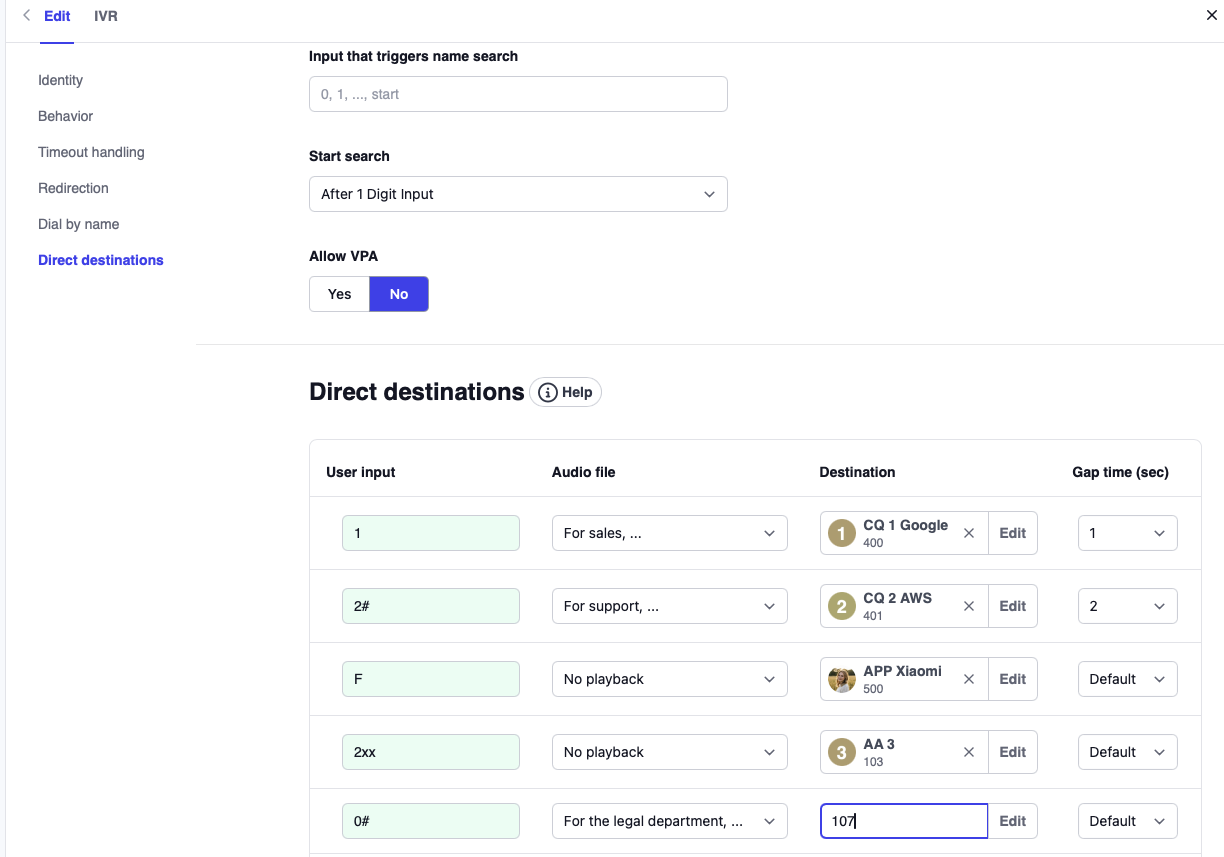
- User input — the digit the caller presses to choose this option.
- Prompt audio — the audio that announces the option (e.g. "For sales, press 1").
- Destination — where the call goes: an internal number (extension, mailbox, conference) or an external number.
- Gap (seconds) — the silence between this option's prompt and the next as the menu is read aloud.
Keep your menu digits clear of the extension range (see above) so a typed extension is never mistaken for a menu key.
The IVR tab
Everything the caller hears, in two sections.
Welcome greeting
- Play default welcome message / Default welcome message file name — whether to play the built-in greeting, and which file (
aa_welcome_auto.wavby default). - Welcome greeting — upload a custom greeting to play when the attendant answers.
- Music on hold source / Background music — the audio source for music, and the volume it's mixed under the spoken prompts at.
- Time between prompts — silence inserted between announcement segments.
- Wait before answering the call (secs) — how long the attendant rings before answering (lets an extension pick up first).
- Welcome messages 1–5 — up to five alternative greetings, each tied to a service flag: when a flag is active its message plays instead of the default (a different greeting after hours, on holidays, and so on).
Entering the destination
After the greeting, the system can speak standard instructions telling callers what to do. Turn each on or off:
- "Please enter the extension number"
- "For our dial-by-name directory, press N" — only plays if you set a dial-by-name trigger key.
- "Or remain on the line for general assistance" — only plays if you set a timeout redirect.
Webhooks
The Webhooks tab fires an HTTP request to your systems on call events (a new call comes in, a call is answered, a call ends with its CDR, and more) — for CRM logging or custom automation.
A worked example — main line for a small office
A company wants its main number answered instantly, with a simple menu, and after-hours calls sent to voicemail.
- Create the attendant from Call flow → Auto attendants → New as account
100, and point the main number at it from Phone numbers. - Record the greeting on the IVR tab: "Welcome to Acme Co. For sales, press 1. For support, press 2. For accounting, press 3. To reach someone by name, press 4, or dial their extension at any time."
- Map the keys under Edit → Direct destinations: slot input
1 →the sales ring group,2 →the support queue,3 →accounting; set the Dial by name trigger to4. - Keep extensions clear by numbering staff in the 4xx range, so a typed extension never collides with a menu key.
- Catch no-input callers in Timeout handling → Redirect number — point it at the receptionist.
- Handle after-hours in Redirection: pick your office-hours service flag and set the night-mode destination to the shared mailbox — then add a matching after-hours greeting as Welcome message 1 on the IVR tab.
Everyday tasks
- Stand up a phone menu → Call flow → Auto attendants → New; record a greeting on IVR, map keys under Edit → Direct destinations, point a number at it.
- Add a dial-by-name directory → set the trigger key under Dial by name and mention it in your greeting.
- Change the greeting after hours → add a Welcome message tied to a service flag on the IVR tab, and set the matching Redirection night destination.
- Stop typed extensions clashing with menu keys → number extensions in the 4xx–7xx range.
- Route by what callers say, not press → use a Voice agent instead.